Reaching new players is one of the most exciting parts of launching a game. You’ve built something worth playing. Now the question is: how far can it go?
For many developers, localization feels like the obvious next step. More languages = more players, right? Well… not always. Expanding your market is powerful, but only if you do it at the right time, and for the right reasons.
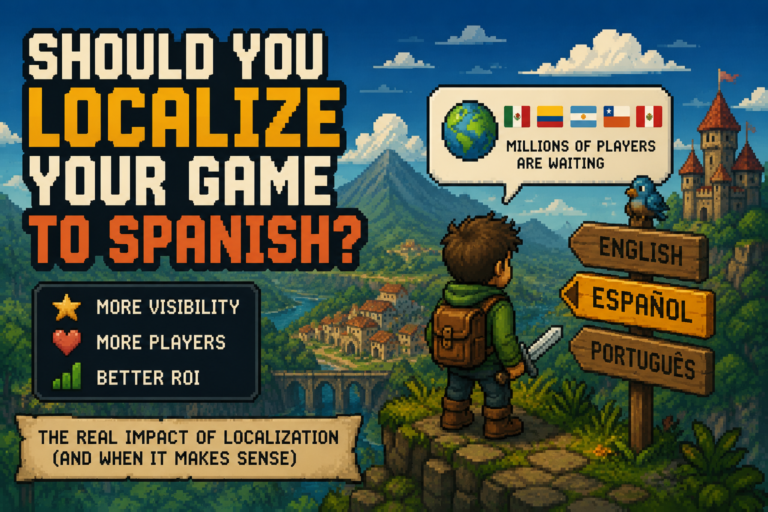
In this post, we’ll break that down properly. When does it actually make sense to translate your game? When should you hold off? And most importantly—why Spanish is often one of the smartest first moves you can make if you’re looking to grow your audience.
Done right, localization isn’t just about translating words. It’s about unlocking entire communities of players who are ready to connect with your game.
The size of the Spanish-speaking gaming market
A massive, often underestimated player base
When we talk about “translating into Spanish,” we’re not talking about a niche market. We’re talking about one of the largest gaming audiences in the world.
According to Newzoo (via Xsolla), Latin America alone had around 335 million players and generated approximately $8.7 billion USD in revenue in 2023, positioning the region as one of the largest and fastest-growing gaming audiences worldwide. More recent projections estimate that the region will reach over 372 million players and more than $8 billion annually, confirming that this is not just a large audience—but a stable, revenue-generating market with increasing purchasing power. In other words, Spanish-speaking players are not a “nice-to-have” audience; they represent a significant portion of the global gaming economy.
And this growth is far from slowing down. According to Market Data Forecast, the Latin American gaming market was valued at around $26 billion USD in 2025 and is projected to reach nearly $79 billion by 2034, driven by increased connectivity, mobile adoption, and a young, highly engaged player base. This kind of growth curve is exactly why more studios are starting to take Spanish localization seriously—not just as a translation step, but as a strategic expansion into one of the most promising regions in the industry.
Spanish is not one single market
Here’s where many developers get it wrong.
Spanish is not a monolithic language in practice: it’s a cluster of regional variants:
- Spain (European Spanish)
- Mexico (the largest Spanish-speaking population)
- Argentina, Chile, Colombia, etc. (each with their own nuances)
And this matters.
Not necessarily at the level of basic understanding—players will generally understand each other—but at the level that actually impacts immersion:
- Tone
- Humor
- Cultural references
- UI phrasing
- Even perceived “quality”
A translation that feels natural in Spain can feel slightly off in Mexico, and vice versa.
LATAM vs Spain: same language, different dynamics
Beyond language, these markets behave differently:
- Spain → more mature, higher spending, closer to other European markets
- LATAM → larger volume, more mobile-driven, extremely engaged
For example:
- Mexico alone has 78+ million players and is one of the largest Spanish-speaking gaming markets
- LATAM as a whole shows strong mobile adoption and high engagement rates across demographics
So when you translate into Spanish, you’re not entering one market—you’re entering multiple ecosystems at once.
What if your budget is limited?
This is where strategy comes in.
Ideally, you would localize separately for:
- Spanish (Spain)
- Spanish (Latin America)
But realistically, many indie studios (and even mid-sized ones) don’t have the budget for that.
So what’s the practical solution?
👉 Neutral Spanish
Neutral Spanish is a compromise approach:
- Avoids region-specific slang
- Uses widely understood terminology
- Keeps tone clean and accessible
Is it perfect? No.
Is it effective? Absolutely.
It allows you to reach both Spain and LATAM with a single localization effort, which is often the smartest move in early stages.
Why LATAM translators are especially valuable here
This is something most people don’t realize.
Latin America is incredibly diverse. Our cultures, accents, slang, humor, and ways of speaking can vary dramatically from one country to another—and yet, they constantly intertwine. Over the years, digital media, online gaming, streaming platforms, memes, social networks, and shared internet spaces have created a kind of linguistic bridge between our regions. We grow up hearing expressions from Mexico, Argentina, Chile, Colombia, Peru, and many others all at once, gradually learning to recognize not only our own way of speaking, but everyone else’s too.
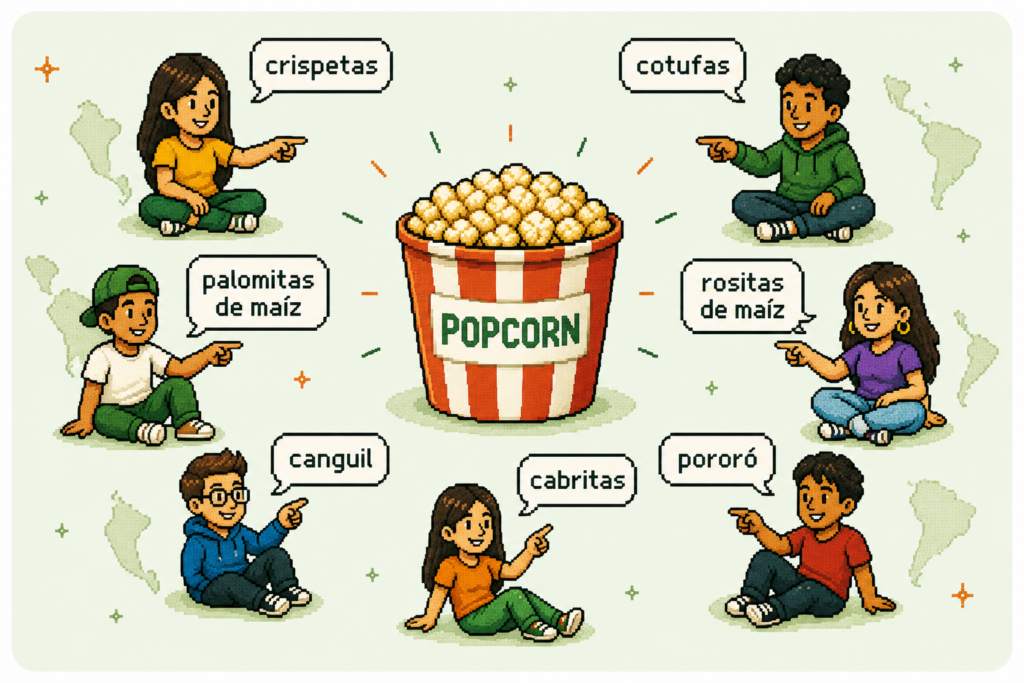
That’s why Latin American translators are often especially skilled at working with neutral Spanish. We understand the subtle differences between regional variants and we have learned to find translation choices that are universally understood across borders. It’s less about erasing cultural identity, and more about weaving those differences together into a version of Spanish that welcomes everyone into the same experience.
In practice, this means they’re usually better at:
- Writing universally understandable text
- Avoiding region-specific friction
- Keeping tone consistent across markets
The cost of not localizing
Localization has a cost. Sometimes a relatively small one, sometimes a significant investment depending on the size of the game, the amount of text involved, voice-over requirements, or the regions being targeted. Spanish localization itself can vary considerably: Latin American Spanish is often approached differently from European Spanish, and large-scale projects may require extensive terminology management, QA, and style consistency work.
But there’s another cost most developers never calculate: the players who quietly move on.
Unlike localization budgets, this loss is almost invisible. A player who cannot comfortably understand your game may never leave a review, never join your Discord, never recommend the game to friends, and never even make it past the store page. From an analytics perspective, they simply disappear before becoming part of the community.
You can measure localization expenses.
You usually can’t measure the players you never reached.
This is especially important in Spanish-speaking markets, where many players are used to consuming localized content and actively look for games available in their language. For story-heavy titles, RPGs, management games, survival crafting games, and even multiplayer experiences with complex systems, language accessibility can strongly influence whether a player decides to buy, refund, or postpone a purchase entirely.
And players do talk about it. A lot.
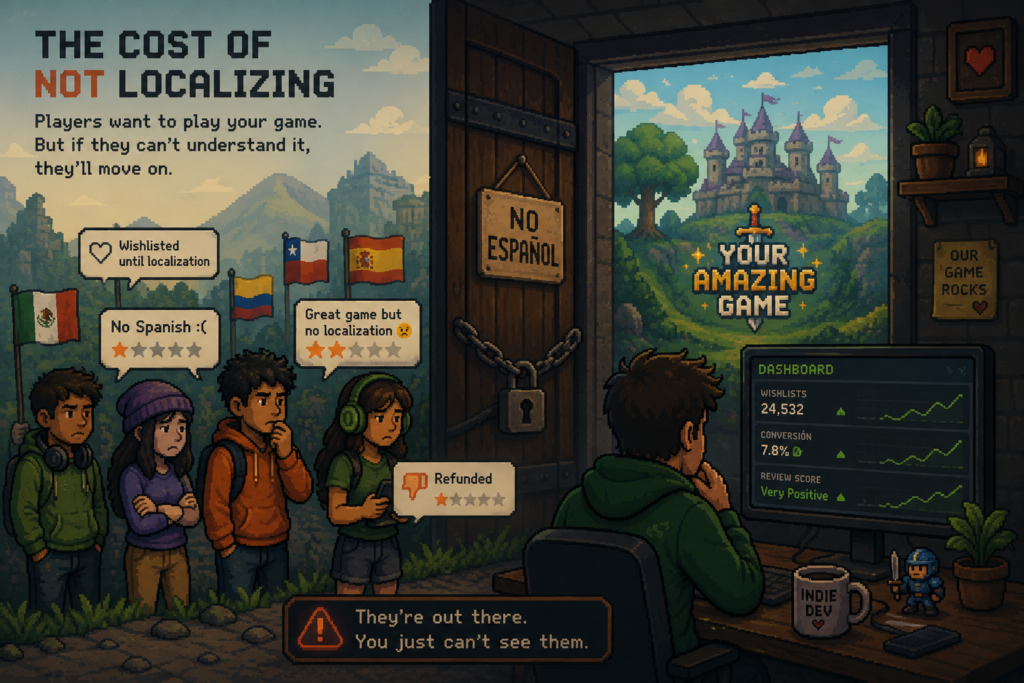
Across Steam forums, Reddit threads, and community discussions, it’s common to see players asking developers to add Spanish localization or openly admitting they skipped a game because it wasn’t available in their language. In some cases, players even mention refunding titles after realizing the language barrier would negatively affect the experience.
Eventually, studios should stop asking themselves: “Can we afford localization?” The real question should be:
“How much are we already losing by not doing it?”
Real ROI of Localization
Measuring the exact ROI of Latin American Spanish localization is difficult. Unlike ad campaigns or direct sales funnels, localization rarely produces a clean “we spent X and earned Y” report. Spanish-speaking players are spread across dozens of countries, platforms, and purchasing behaviors, and most studios simply do not publish language-specific revenue breakdowns.
Still, what is publicly available paints a very clear picture: the Spanish-speaking gaming audience is enormous, highly active, and still growing.
Latin America alone is estimated to have more than 335 million players, making it one of the largest gaming regions in the world. Mobile gaming is especially dominant in the region, with billions of dollars in annual revenue and extremely high player penetration across countries like Mexico, Argentina, and Colombia. Newzoo estimated the Latin American mobile market generated around $3.5 billion USD in consumer spending, while other market reports project continued long-term growth.
And this audience is not limited to free-to-play mobile games.
What the industry does know with certainty is that localization strongly affects discoverability and visibility — especially on platforms like Steam.
Steam’s storefront and recommendation systems use language metadata to determine which players are more likely to see a game. This means localized store pages, supported interface languages, subtitles, and translated descriptions can influence regional visibility, search placement, recommendation relevance, and conversion rates.
And perhaps most importantly: localization ROI is rarely immediate.
Over months or years, this can turn into a snowball effect.
A translated game does not suddenly explode overnight because a new language was added. The real effect is usually slower and cumulative. More players enter the funnel. More wishlists convert over time. More creators stream the game. More community discussions happen organically. More players feel comfortable staying, recommending, reviewing, and returning after updates.
For instance, take massive paid titles like World of Warcraft and Call of Duty. These have maintained extremely active Spanish-speaking communities for years, across both Latin America and Spain. Spanish-language servers, forums, Twitch communities, Discord groups, esports broadcasts, and fan content consistently pull massive engagement. In the case of Call of Duty, Latin America has become one of the strongest regions for mobile competitive play, estimating a 20 million revenue in e-sports by 2027.
When NOT to Localize
Despite everything we’ve discussed so far, localization is not always the right move — at least not immediately.
This is important: localization is not a magical “growth button,” but an amplifier. Translation works best when there is already something worth amplifying: a solid game, a clear audience, and at least some level of traction or long-term plan.
If a project is still in a very early prototype stage, for example, full localization may not make financial sense yet. Mechanics change constantly, UI gets rewritten every week, narrative systems evolve, and large portions of text may eventually be discarded. In these cases, localizing too early can create unnecessary costs and maintenance work.
Some studios prefer to wait until their UI becomes more stable, their Steam page is finalized, or their Early Access roadmap is clearer before investing in full localization. Others begin by translating only the store page or interface first, expanding into full narrative localization later as the community grows.
And honestly, that approach makes a lot of sense.
Localization is most effective when it supports momentum: wishlists increasing steadily, creators showing interest, players engaging with the demo, or a community slowly forming around the game. At that point, adding Spanish can help remove friction and make the game more accessible to millions of additional players.
That said, you don’t need to wait until the “perfect moment” to start preparing.
Even if you’re not ready to localize immediately, getting an early quote can still be extremely useful for planning budgets, timelines, update pipelines, and future expansions. It helps developers understand the real scope of the project long before launch pressure begins.
If you’re planning on localization, you should also be aware of the best practices and steps you should take during early stages to make the process a lot smoother later on. In this post, we expand on how clean string management, avoiding hardcoded text, maintaining consistent terminology, and planning UI space early will make your life much easier when expanding your game’s reach.