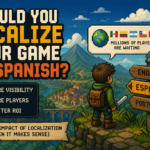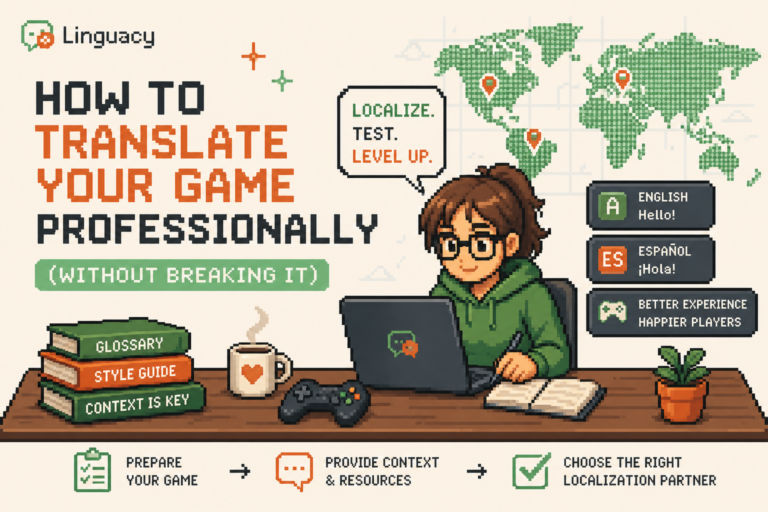
Shipping your game without Spanish localization in 2026?
That’s not a creative decision. That’s leaving revenue on the table.
But here’s the thing: translating a game isn’t just about converting text. It’s about making sure your game feels right to players who experience it in another language.
If you’ve ever seen a UI overflow, a weirdly translated skill name, or dialogue that just feels… off, you already know what we’re talking about.
So let’s answer the real question:
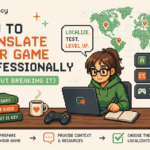
How do you translate your game professionally — without breaking the experience?
Why translating your game into Spanish matters
1. This is not a niche market
Spanish is one of the most spoken languages in the world, with 500+ million native speakers globally.
More importantly for you:
- Latin America is one of the fastest-growing gaming markets (Newzoo)
- Countries like Mexico, Argentina, and Colombia have massive player bases
- Spanish is consistently among the top languages requested by players on platforms like Steam
If you’ve ever read reviews like:
“Great game, but no Spanish…”
…that’s your signal.
2. Localization has a real ROI
Localization costs money, yes.
But not localizing costs you:
- visibility
- conversions
- retention
There are well-documented cases (especially in indie games) where adding Spanish post-launch led to:
- spikes in reviews
- increased player engagement
- broader regional reach
Players are far more likely to:
- buy your game
- recommend it
- stick with it
…if they actually understand it comfortably.
3. Better immersion = better reviews
A technically correct translation is not enough.
Players don’t think:
“Ah yes, grammatically acceptable.”
They think:
“This feels weird.”
The true goal of a good localization is simple: make the players feel this game was not translated for them, but CREATED for them in their native language. And the way to achieve that is implementing a localization that:
- respects tone and character voice
- adapts cultural context
- avoids literal translations that break meaning
How to actually translate your game (step by step)
1. If you’re still in development: prepare early
✔ Separate text from code
No hardcoded strings inside scripts.
Use:
- JSON
- CSV
- localization tables
✔ Use clear keys (not chaos)
Avoid:
STR_001
STR_002
Use:
MENU_START_BUTTON
ITEM_HEALTH_POTION
✔ Plan for UI expansion
Spanish text is usually longer than English.
If your UI barely fits English:
- it will break in Spanish
✔ Add context (this is huge)
“Save” can mean:
- guardar
- salvar
- ahorrar
Without context, translators guess.
2. If your game is already built (don’t panic)
Most projects land here.
✔ Extract your strings
Get everything into:
- JSON
- CSV
- Excel
✔ Identify risky areas
Watch out for:
- concatenated strings
- variables inside text
- UI limits
✔ Expect some rework
You may need:
- UI adjustments
- minor code tweaks
3. When you’re ready to send for translation
✔ Provide:
- source files
- character limits
- screenshots or videos
- glossary
- tone guidelines
✔ Clarify your audience
Are you targeting:
- Spain
- Latin America
- both
✔ Set expectations
- timeline
- revision rounds
- QA process
The final step: choosing the right provider
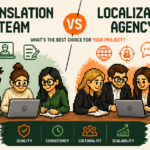
1. Your options
Freelancers
- ✔ flexible
- ✔ affordable
- ❌ inconsistent at scale
Localization agencies
- ✔ structured
- ✔ scalable
- ❌ often expensive
- ❌ sometimes impersonal
Translation teams
- ✔ consistent
- ✔ direct communication
- ✔ scalable
Here’s a post that may help you figure out the best choice for you!
2. What actually matters
Look for:
- experience in games
- understanding of context and tone
- UI awareness
- QA / LQA knowledge
3. Where Linguacy fits in
At Linguacy, we focus on:
- game localization
- in-game LQA
- consistency across updates
We don’t just translate strings.
We make sure your game:
- reads naturally
- fits the UI
- feels right
Final thoughts
You don’t need to overcomplicate the process, but you do need to take it seriously. Players will notice when your game feels polished—and when it doesn’t—and in a crowded market, that difference can have a bigger impact than you might expect.